The thread that sews it together
The Free Line
Getting to a clinic, a job, a grocery store, a beach or a friend is a right, like water and light.
This is a proposal. It is an idea for Sheboygan, not a city plan or a decision.
The dream
Half of the world is already built: a lake, a river, a lakefront drive, a downtown with a stage. What it lacks is the thread. So sew it.
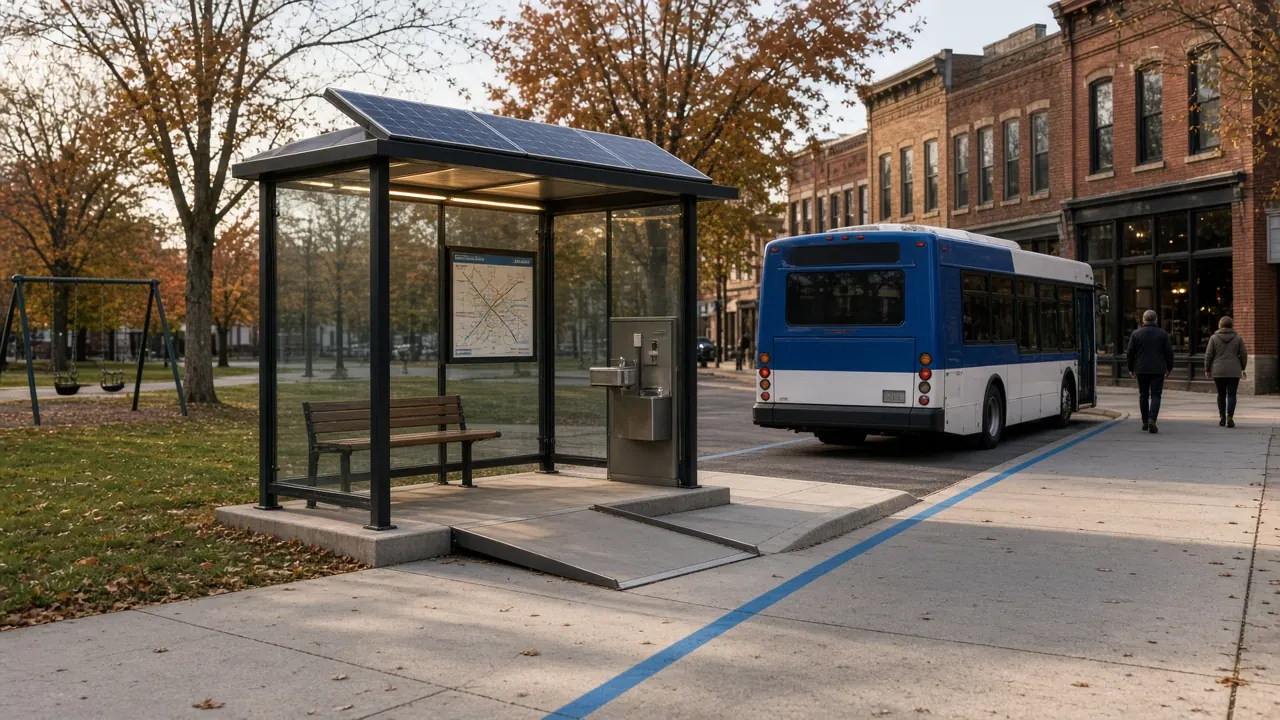
The bus is free. A heated line glides up Broughton Drive every few minutes, with a warm shelter at every stop, a ramp for wheelchairs, and a swing or a sculpture in sight. A small electric vehicle comes to your door, owned by the city. Express runs go straight from neighborhoods to big employers. A coach leaves downtown for the towns around us. A person can live here on one car, or none.
Four zones, three hubs
- Lake Zone: Broughton Drive, the Basin, Deland and North Beach, the Armory Garden, the Y, the Arts Center, Downtown Commons, and across the river the South Pier and the Geode. People first, cars as guests.
- North, South and West Zones: the neighborhoods and business corridors beyond the lake, each with its own small fleet and pickup points.
- Downtown Hub: the Transfer Station block, where every route already meets.
- Basin Hub: the lakefront living room, 821 Broughton Dr.
- Geode Hub: the south-bank door and the start of the Swing Trail.
Six ways to move
- The Free Line: a heated, fare-free electric bus loop up Broughton Drive and back on an inland street.
- The Pod: the city’s own point-to-point vehicle you summon with a phone or a button at a stop. Some are wheelchair-accessible.
- The Flyer: a peak-hour express from a neighborhood stop straight to a big employer.
- The Regional: a comfortable coach with luggage space and a bike rack to nearby towns.
- The Bike: shared e-bikes and e-trikes at every hub.
- The service van: the quiet one that keeps the rest alive.
One monthly pass could cover every ride, an e-bike, and a few car-share hours for the day you truly need a car.
Why free
Fares are a small slice of the cost and a big wall for riders. The idea is that free is the door and frequency is the room behind it: more riders need more service, and every added hour is a number we can count in advance.
A first year, in small steps
- Free and human-driven. Fare-free on every line. A heated Free Line runs on Broughton Drive. The first Regional leaves for Plymouth twice a day. Shared bikes dock at the Basin, the Geode, the Weill and the Y. The city surveys every alley and every stop.
- Then zones, Flyers, and the West and South Lines. Broughton Drive is a place to build the right curb stops while the road is open.
- Later, maybe, automation. Automated shuttles are a possible far-off step that depends on state law and on how they handle a Wisconsin winter. This page does not rely on them.
Zones keep trips short, and on-demand rides serve only a few riders per hour, so the Pod is for thin hours and long last-mile gaps while fixed trunks carry the crowds. Today’s buses can absorb some growth, but the Free Line and Flyers need added hours. Costs, staffing, and funding have not been studied.
The regional runs
Computed by our research notes from public map data, not from timetables. Distances run from the Weill to each town’s center.
| Town | Straight line | By road | Free-flow drive |
|---|---|---|---|
| Plymouth | 13.2 mi | 14.7 mi | about 21 min |
| Random Lake | 18.7 mi | 23.6 mi | about 37 min |
| Port Washington | 26.4 mi | 28.5 mi | about 35 min |
| Fond du Lac | 36.6 mi | 40.6 mi | about 54 min |
Start with two round trips a day to Plymouth, timed for first shift and late afternoon. Add the other towns as demand and hours allow. Source: RESULT-futurist-mobility-system-2026-10-03.md (a proposal file, not a fact base).