
Paying For It
Fare-free first: about $0.5 to $0.6M a year. The bigger network phases in later ($13.8M starter, $22.6M full).
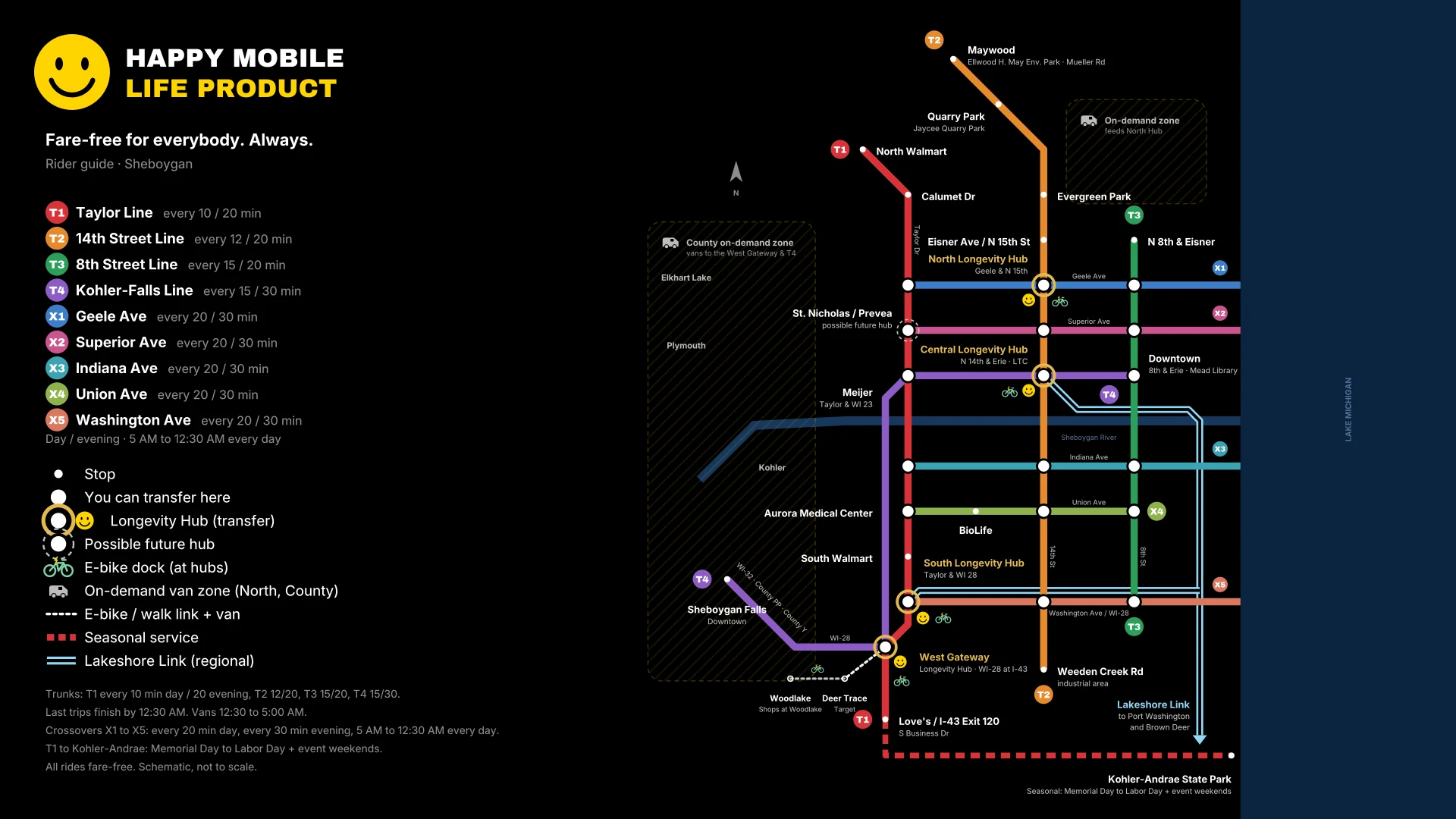
Photo slot (Hub rendering)
Moving people, not storing cars.
We designed the network to be fundable with tools Wisconsin communities already use.
The base that already exists
- State urban transit aid (Wis. Stat. 85.20) and federal transit formula funds (FTA 5307) already pay a large part of running Shoreline Metro.
- Federal and state programs for accessible vans (5310 and 85.21), rural service (5311), intercity links (5311(f)), new buses (5339 and Low-No), and clean-air startup service (CMAQ).
- Local shares from the city, and from the county as the network becomes countywide.
- Safe Streets, transportation alternatives and charging grants for paths, crossings and chargers.
Money not yet spent
The city's long-range plans include large future projects that haven't been built or borrowed for yet. The TID 21 project plan lists two downtown parking structures, at $12 million in 2035 and $10 million in 2045, $22 million in all. The planned pedestrian bridge also carries a local share beyond its federal grant, which isn't spent yet.
Our idea is simple: as more people ride a frequent, fare-free network, downtown needs fewer parking stalls. Building big parking ramps just as the post-ownership era arrives means overbuilding for the past. Every stall not built is money for moving people.
Rides to recovery: unspent opioid money
Sheboygan County's opioid settlement share is about $3.97 million over 18 years. It spent about $315,000 in 2024 and 2025, none on transportation, and $1,815,678.60 was unspent at the end of 2025 (Legislature report, pp. 309 to 317). The settlement's allowed uses include “transportation to treatment or recovery programs or services” (Exhibit E), and other Wisconsin counties already fund rides (Wisconsin Watch). Our plan: a share helps run fare-free service on recovery and clinic routes and the overnight on-demand. Research.
Capital first, so operating money goes further
Wisconsin's tax increment financing (TIF) rules matter here. TIF can pay only for project costs listed in a district's adopted plan, and changes need a plan amendment approved by the Joint Review Board. It can build capital: hubs, shelters, stops, e-bike stations, chargers and street and bike-lane work. It can't pay to run buses.
So we use TIF for what it does best. It builds the Hubs, stations and chargers. That frees city, state and federal dollars to run more service. The federal bridge grant stays with the bridge, and our plan counts only local dollars.
Why fare-free costs less than you'd think
- Fares cover a small slice of today's costs: about $546,000 a year.
- Fare collection, passes and special programs have their own costs, which go away.
- All-door boarding keeps buses on time, so the same buses deliver more service.
The household math
AAA's 2025 Your Driving Costs study puts the average cost of owning and running a new car at about $11,577 a year, roughly $965 a month. Sheboygan's median gross rent is about $924 a month, about $11,088 a year (ACS 2020-2024).
One car costs more than a full year of median rent. Every household that gives up a car keeps that money for housing, food, savings, a small business or a trip, and much of it stays in Sheboygan.
Our estimates, honestly
We built our costs from Shoreline Metro's own 2024 figure of about $94.65 per revenue hour.
- The full network on the every-day schedule is about 211,700 bus-hours a year, roughly $20 million.
- With vans and fare-free service, the full vision comes to about $22.6 million a year.
- A starter network comes to about $13.8 million.
These are 2024-dollar estimates before new aid, and we'll refine them with quotes. We can build it in steps, starting with fare-free service, the every-day schedule on the busiest lines, and vans, then growing toward the full network. The money exists, in public programs and in plans not yet spent. The choice is what to build with it.
A new car costs more than a full year of rent.