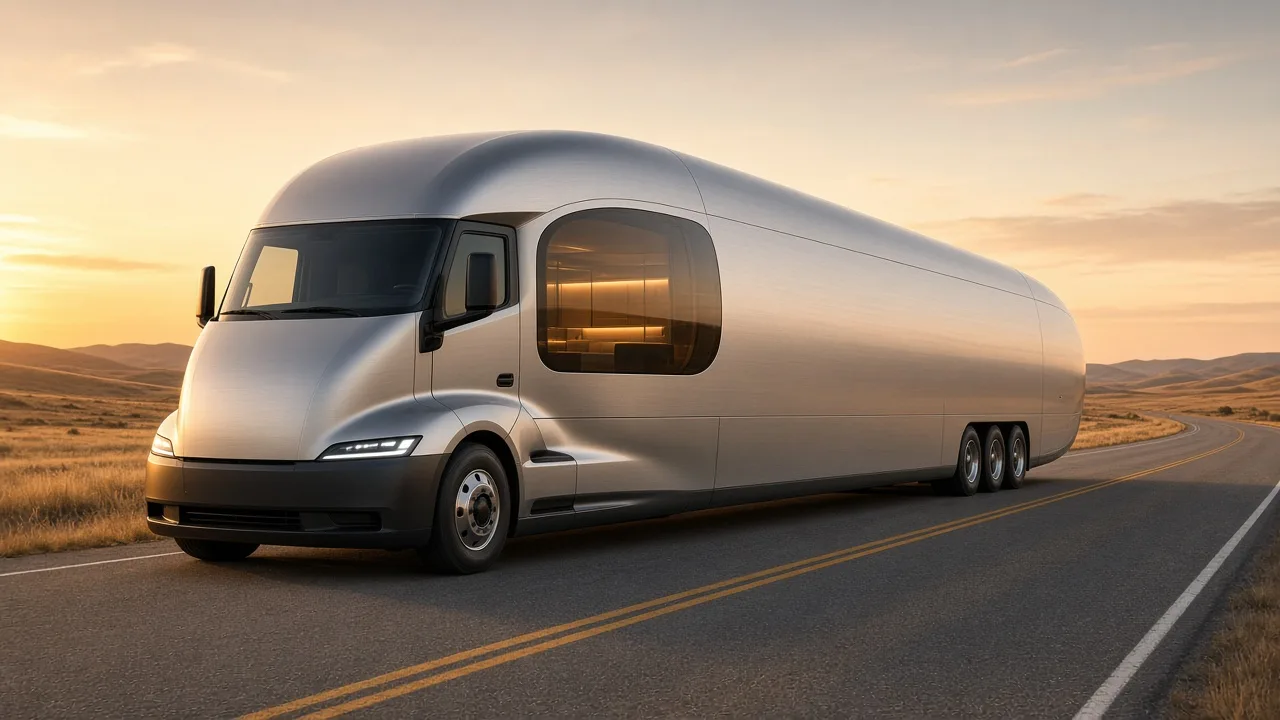
Concept render: the exterior. One smooth shell, nothing that folds or slides.
The Ultimate Travel Device for Two People in Love
One calm, open room for two, shaped like a polished river stone, pulled and powered by a Tesla Semi, with nothing that folds, slides or unfolds.
Concept brief. Draft, October 26, 2026.
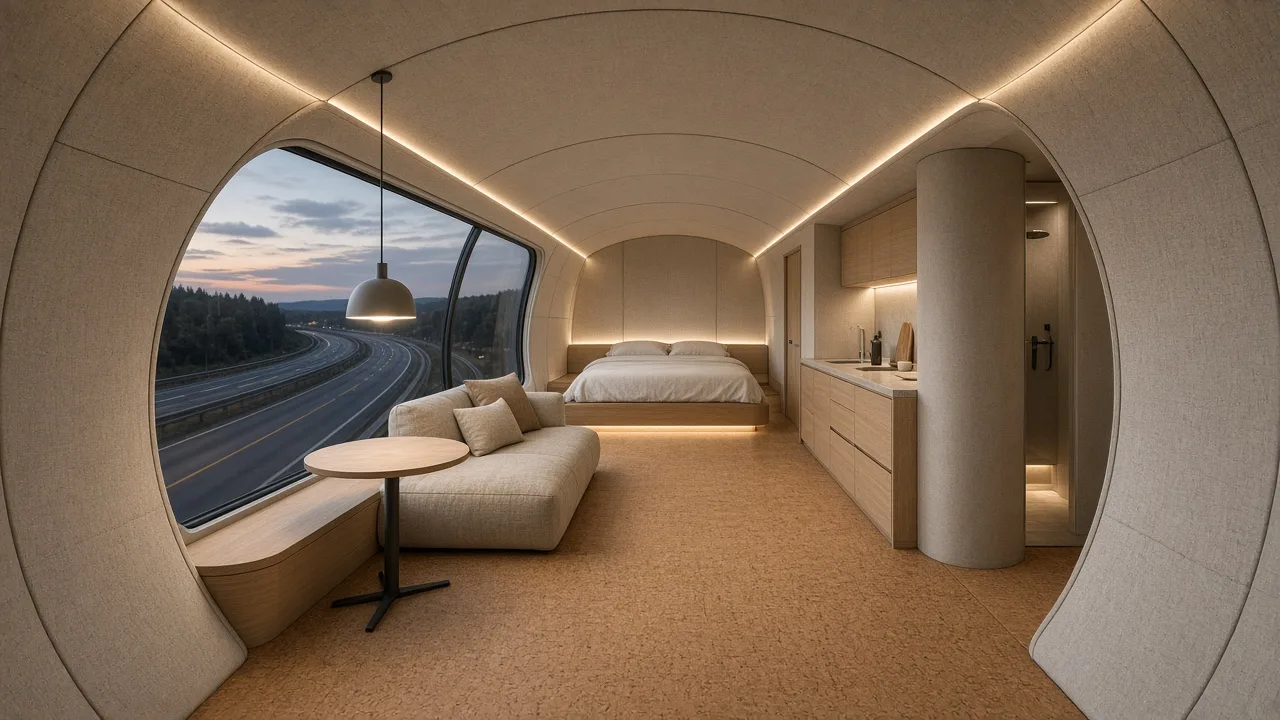
Concept render: the interior. One open room, soft light, quiet surfaces.
Design principles
Fixed form. No slide-outs, pop-tops, hinges or moving parts. What you see parked is what you see on the road.
One room. A single open volume, never chopped into small rooms. Only the wet block is enclosed.
Light weight. Fewer parts, fewer joints, less to break, less to carry.
Always on. Everything stays attached, strapped down and powered while moving. No setup when you arrive and no teardown when you leave.
Quiet. Soft surfaces, sealed gaskets and gentle air, so the room feels still even at highway speed.
One of each. One bed, one couch, one table, one bench, one light source. Nothing converts into something else.
Room for love. Comfort for two, plus a little private corner for each person.
Name options
Two Moons, The Pair, Driftroom, Lovepod, The Long Quiet, Happy Mobile Home (a sibling to Happy Mobile Life), Stillwater.
Shell
Airstream-inspired rounded aerodynamic skin over a 53-foot dry van footprint: 53 ft long, about 8.5 ft wide, under the 13 ft 6 in legal height.
Smooth nose that flows from the Semi's cab, tapered tail, skirted sides.
Glass up front for the forward view, kept within the shell's fixed lines.
Seamless skin with rubber-gasketed joints, no exterior slide seals.
The numbers
About 440 sq ft. About 4,000 cu ft.
Floor: about 440 sq ft (inside a standard 53 ft van, about 52.5 ft by 8.4 ft).
Volume: about 4,000 cu ft, roughly 2,000 cu ft per person.
NASA's minimum for long missions is about 883 cu ft per person. A 1963 study called 90 sq ft of floor or 700 cu ft per person optimum.
The Apollo lunar module gave two astronauts about 160 cu ft total. This gives about 25 times that.
Two people at NASA's minimum need about 23 ft of length. The rest becomes generous living space and a sealed equipment bay.
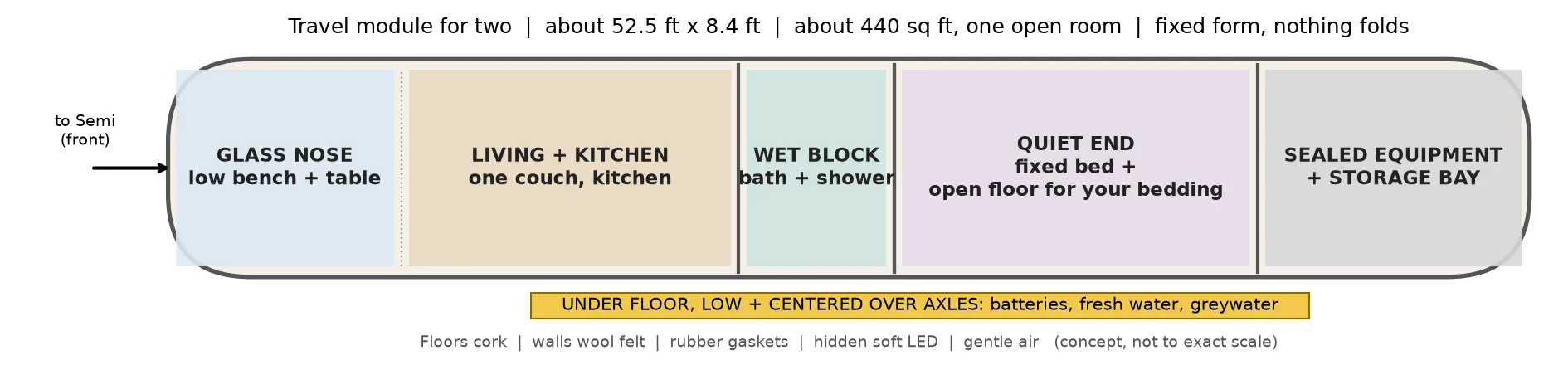
Layout, front to back
Based on NASA's seven functional zones.
Floor plan, front to back. Tap to open it full size.
Front: glass, the low bench and the table. Morning coffee facing the road ahead.
Middle: the real couch, the kitchen and the shared living space. The heart of the room.
Wet block: one enclosed bathroom and shower, with all plumbing in one short run.
Quiet end: one fixed bed. Next to it, open flat floor where you can lay down your own bedding.
Rear: sealed equipment and storage bay for gear, tools, spare water and systems.
Underfloor, low and centered over the axles: batteries, fresh water and greywater tanks.
Each person gets one small private nook (a shelf, a reading corner or a curtain line), because the space research says private space matters most on long trips.
Materials and feel
Floors: cork. Warm, soft, quiet and light.
Walls: wool felt panels for sound and warmth.
Seals: rubber gaskets everywhere a panel meets a panel, so nothing rattles.
Lighting: soft hidden LED strips washing the ceiling and floor edges, with one main light source you choose.
Air: slow, gentle air movement and fresh-air exchange, no blasting vents.
Finish: a few honest materials, repeated. Simple and uniform.
Power and systems
Runs off the Semi's electric power, so the room stays powered while driving.
Battery and water sized for long stays off the grid.
Systems live in the sealed rear bay and under the floor, out of sight and serviceable.
What makes it different
Most RVs and fifth wheels rely on slide-outs, fold-downs and divided rooms. This has none.
Built for two people, not for sleeping six.
Electric and quiet from the ground up, not a diesel camper with a battery added on.
Treated as one beautiful room, closer to a small loft or a quiet chapel than to a camper.
Fixed and simple means fewer things to break, lighter weight and lower upkeep.
Open questions
Exact shell construction and weight target.
Whether a builder will quote a custom body on a Tesla Semi. No published prices exist yet.
Legal length and permit rules for a long living trailer state by state.
From One-Off to 10,000
Build one and it is a masterpiece. Build 10,000 and it is a movement. Here is how the money works.
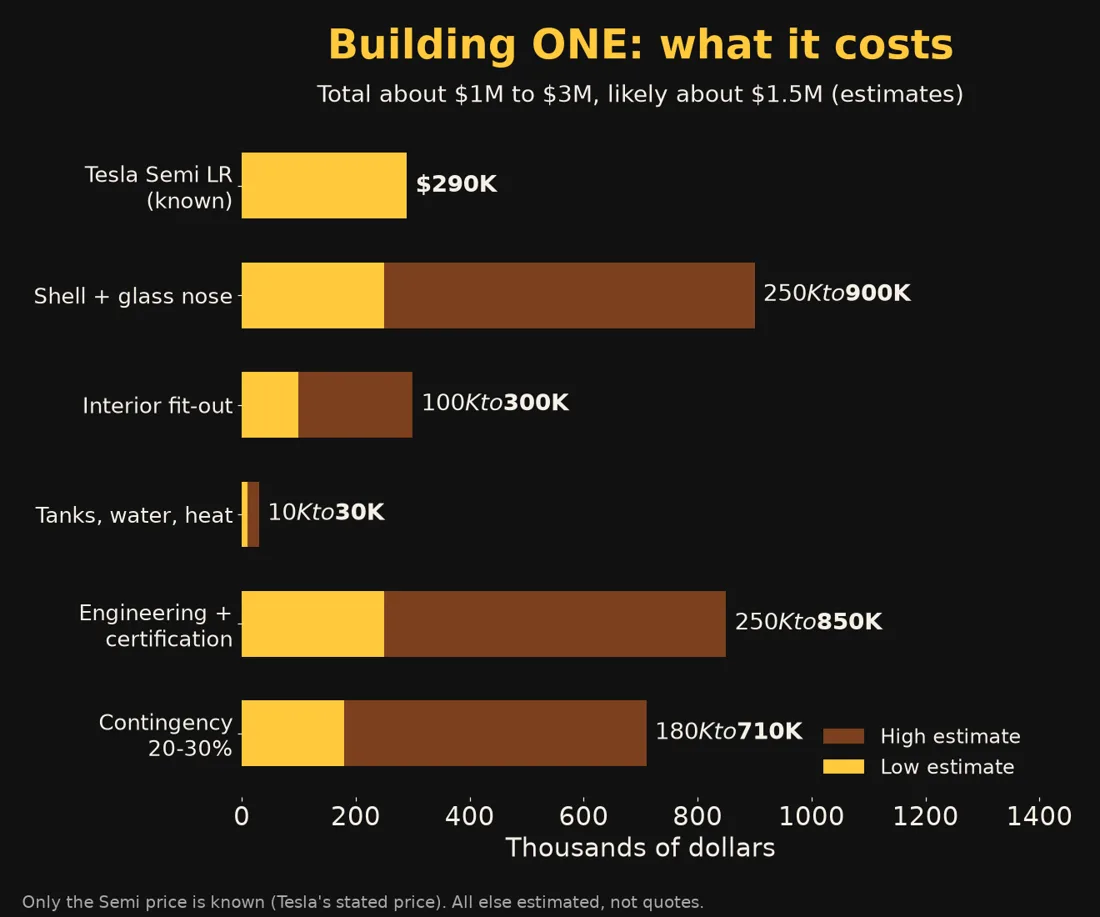
Building one: what it costs
Only one number here is known: the Tesla Semi Long Range at about $290,000, Tesla's stated price. Everything else is our estimate, based on what one-off custom coach and expedition builds typically cost. These are not quotes.
Estimate: cost to build one. Not a quote.
Tesla Semi Long Range: about $290K (known).
Custom shell, including the curved glass nose: $250K to $900K (estimate).
Tanks, fresh water, greywater and freeze protection: $10K to $30K (estimate).
Engineering, design, custom chassis and certification, including the Semi power link: $250K to $850K (estimate).
Contingency for surprises: add 20 to 30 percent (estimate).
Estimated total: about $1 million at the low end to about $3 million at the high end. A likely middle is about $1.5 million.
No separate house battery
The room runs off the Semi's own battery pack. That drops the separate house battery and saves roughly $40K to $120K (estimate). It also makes the custom power link to the truck the single most important piece of engineering.
The cab
As far as we know, Tesla does not sell the Semi as a bare cab or chassis to other builders. Building the room in at that deep level would take a direct deal with Tesla. At real volume, that becomes a realistic conversation.
The big cost drivers
The one-off shell and the tooling for the curved glass.
The custom power link to the truck.
Certification as a federal trailer manufacturer.
Would it sell at $3 million?
Yes, to a few. Luxury motorcoaches already sell in that range, but in the hundreds per year, not thousands. At $3 million, this is a handful of handmade one-offs.
The magic of 10,000
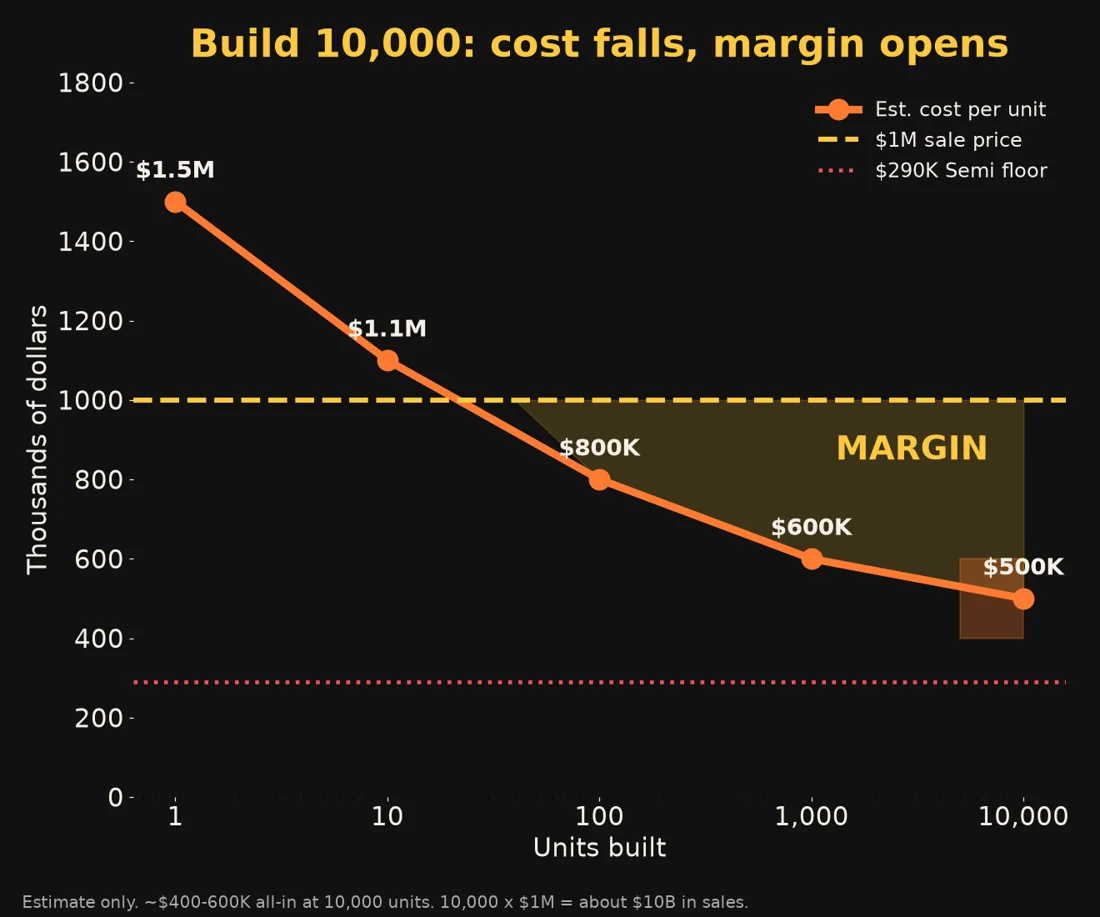
At volume, everything changes. The molds, glass tooling, engineering and certification get paid for once and spread thin across every unit. Interiors move from craftsmen to a calm, repeatable factory line. The $290K Semi becomes the floor. Our estimate: about $400K to $600K per unit, all in.
Estimate: cost per unit as volume grows.
Sell at $1 million each
That is a healthy margin on every unit. 10,000 units is about $10 billion in sales (estimate). The real challenge is not building them. It is finding 10,000 buyers. A module-only version for people who already own a Semi opens the door much wider.
The point
Two people in love, one calm room, and the whole open road. No car to own, no house to tie you down, just freedom that travels with you. Car-free is not giving something up. It is the upgrade.